
Running Gait: Overstriding, Part 1
If you are a runner, you have probably heard of the term “overstrider.”
But what exactly is it? And why does it matter?
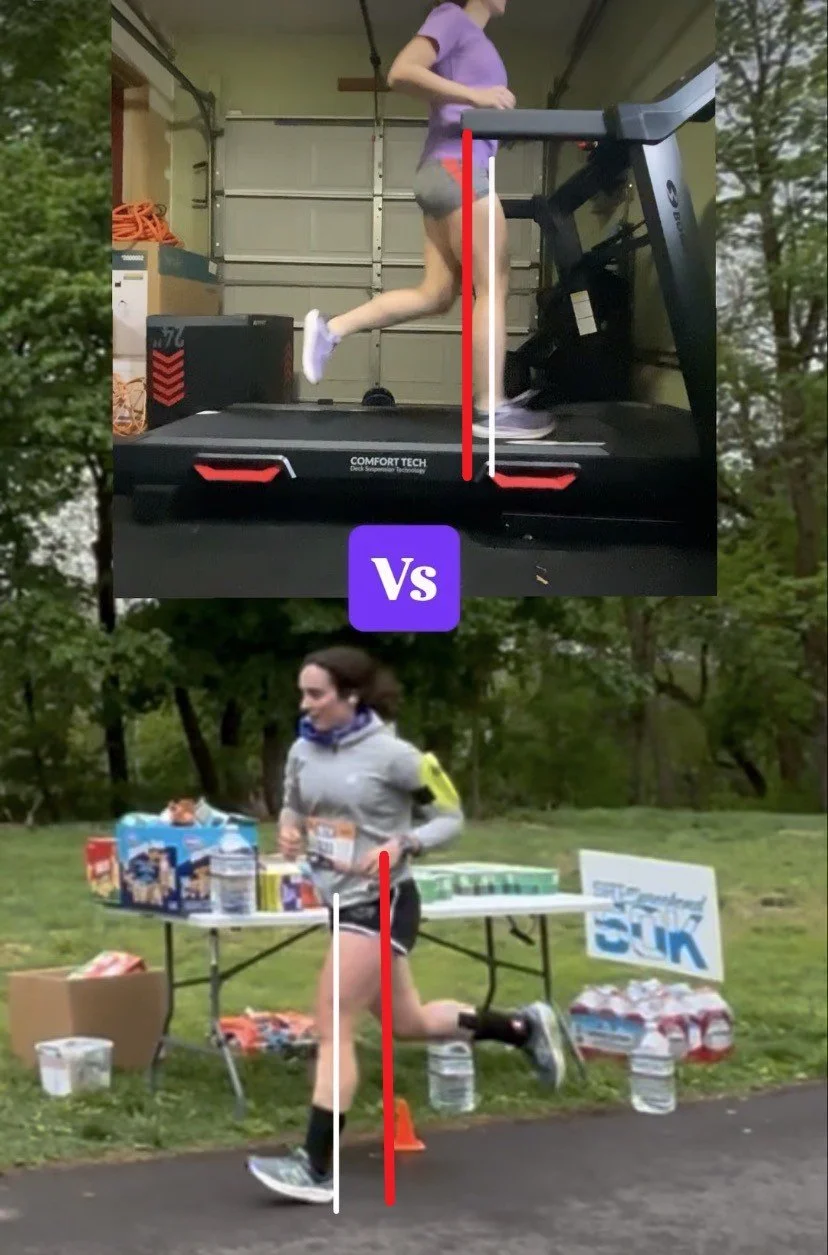
One of the most common running patterns we see, especially in newer runners, is an overstride. This is where the runner lands with their leg relatively far in front of their body. You can see this distinction in the comparison photo above:
At the bottom, the first thing you might think is that I’m heel striking. But that is not the main issue. In fact, you can still overstride as a forefoot striker. The issue is that I am striking so far in front (the angle of the photo isn’t the best) that the point of contact (my heel where the white line runs through) is pretty far in front of my center of mass (the red line).
At the top, you’ll see I’m landing with my foot so that the distance between the white and red lines is MUCH smaller.
So why does this matter?
Running is a repetitive sport. While the body is certainly resilient, certain movement patterns can increase risk of injury, especially as running volume increases.
Overstriding can lead to increased braking forces of the leg. Think of it as braking when you drive. If you see the stop sign in time and you slowly come to a stop, you barely feel the car slowing and stopping. You might even be able to accelerate smoothly without any jerks.
But if you notice the stop sign at the last minute, your reaction is to hit the brakes hard which not only sounds terrible, but jolts the car and everyone in it. If you do that over and over, your brakes are likely going to wear out a whole lot quicker.
Same thing with the body. As we land too far in front, you’re fighting against momentum instead of rolling with it, forcing the body to withstand larger forces which, accumulated over time, can lead to shin, knee, hip, even back pain.
Oftentimes, we will see this coupled with an extended knee (i.e in the bottom picture, you can see my shin and foot in front of the white line, versus the top picture where the line runs perpendicular with my shin) and increased ankle dorsiflexion (i.e. in the bottom picture there is a large gap between most of my foot and the ground, versus the top where my foot lands pretty flat). This transfers more load and stress to the joints versus the muscles.
Not only can overstriding contribute to injuries, it also reduces running efficiency. Overstriding tends to force you to spend more time on the ground, when ideally you spend less time while producing more power. Again, you are also fighting momentum, so you are basically being pushed back with each step.
So in summary, overstriding:
Happens when we land too far in front of our body
Increases braking forces which can lead to higher loads on our joints
Reduces running efficiency
Now that we know what overstriding is, we will discuss in Part II some common causes for overstriding, as well as how to address it!